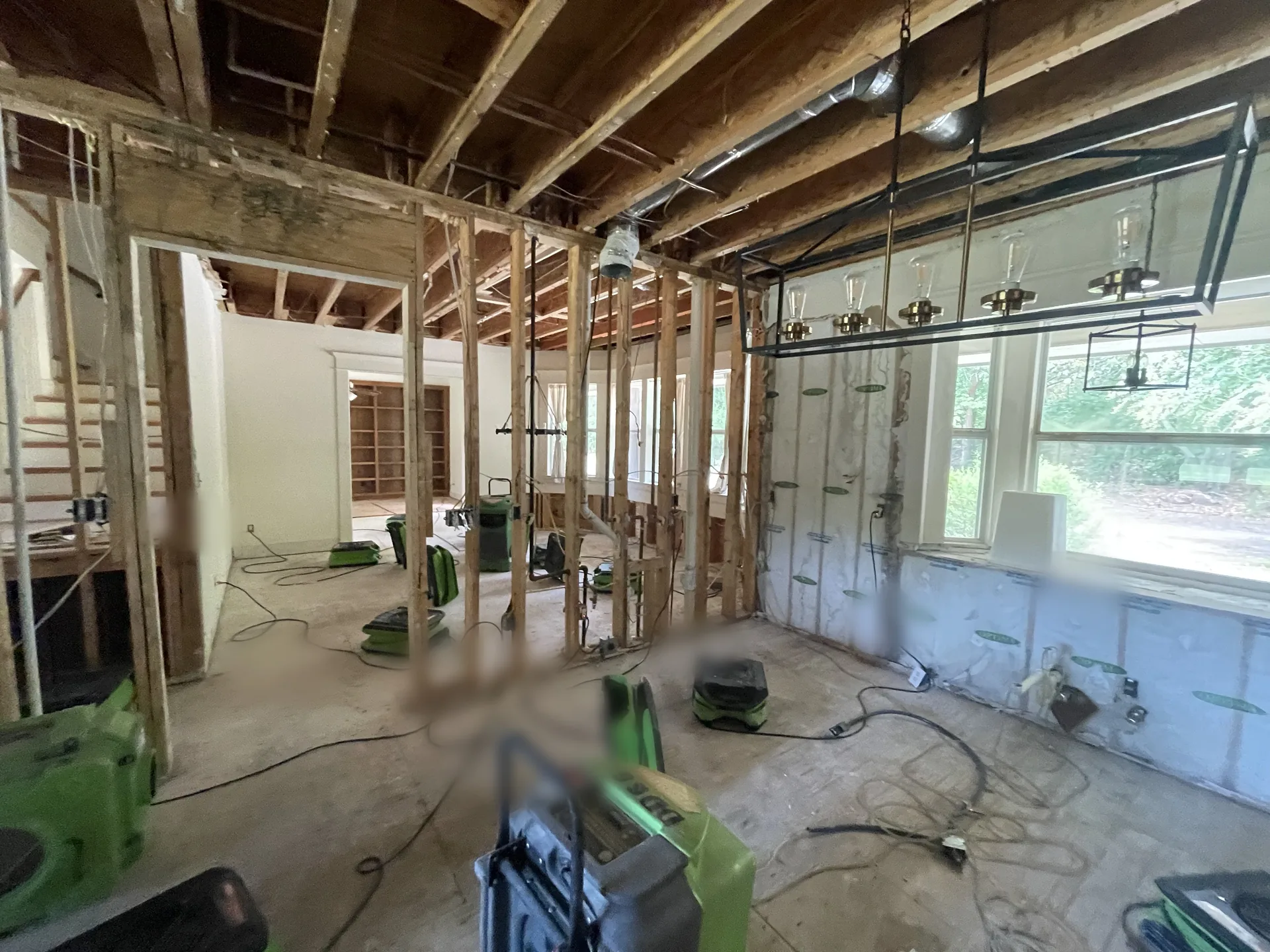
Why nobody can price your job sight unseen
The industry standard for water damage work, ANSI/IICRC S500, starts with information gathering: how big the affected area is, how many rooms and floors, what materials got wet, how old the house is, and whether it's had water before. The standard lets a restorer make assumptions from that first call to send the right crew and equipment. It also says plainly that once the restorer shows up and inspects, those assumptions can change.
That's the whole problem with a phone quote. Water runs under walls, into cabinets, down through ceilings, and across subfloor you can't see. Fire pushes smoke and soot into rooms the flames never touched. What you see from the doorway is usually a fraction of the job.
Our own FAQ says it the same way: price follows what we see on site. We don't quote a rebuild from a photo of a stain.
Why a per-square-foot price misleads
Cost-per-square-foot is the number people search for, and it's the one that fools people the most. Here's why.
- Water doesn't spread by the square foot. Two rooms the same size can be completely different jobs. One has wet carpet over slab. The other has hardwood, cabinets, a wet wall cavity, and a ceiling below it.
- Walls and ceilings aren't floor area. A lot of the work happens up the wall and overhead. A floor measurement doesn't count any of that.
- Drying runs on equipment and days, not area. How many air movers and dehumidifiers it takes, and how many days they run, depends on how wet things are and what they're made of.
- Category changes everything. A square foot of clean supply-line water and a square foot of sewage are not the same work.
- Rebuild depends on finishes. Builder-grade paint and carpet is a different rebuild than site-finished hardwood, custom cabinets, and a Level 5 wall.
A per-square-foot number is an average of other people's jobs. It isn't yours. Ask for a written scope built from your house instead.
What actually moves the cost
1. How big the loss is, how far it spread, and how fast it was caught
Water keeps moving until the source is stopped and the water is pulled out. The longer it sits, the farther it wicks up drywall, under flooring, and into cabinets and framing. A loss that's caught and extracted early usually reaches less material than one that ran overnight or sat for days. A slow leak that ran behind a wall for months can be bigger than it looks from the room. Why small leaks become big problems
That's also why finding the edges matters. We map wet against dry with meters and thermal imaging so the scope covers where the water actually went, not just where it's obvious. How thermal cameras find hidden water
2. What kind of water it is
S500 sorts water into three categories by how contaminated it is, and the restorer sets the category on site after inspecting, for the purpose of writing the scope.
- Category 1 is clean water, like a burst supply line. Under S500, the restorer can dry it without contamination controls.
- Category 2 is water with some contamination, like appliance discharge.
- Category 3 is grossly contaminated. S500 lists examples like sewage, drain backups from beyond the trap, and rising water from rivers and streams.
For Category 2 and 3 water, S500 calls for contamination controls, such as containment barriers and air pressure control, plus protective gear for the crew. More of the porous material, like carpet pad and drywall, typically comes out instead of being dried in place. That's more labor, more haul-off, and more rebuild. Sewage and Category 3 water · Sewage backup cleanup in Fort Worth
3. How many drying days, and how much equipment
Drying isn't a fixed package. S500 has the restorer set dry standards and drying goals at the start, and the job is done when the readings say so, not when a calendar says so. We take readings from unaffected material of the same type in your house and dry the wet material back to that.
The equipment follows the moisture map:
- Air movers push air across wet surfaces so the water evaporates.
- Dehumidifiers pull that water back out of the air so it doesn't soak back into the house.
- Air scrubbers filter dust and particles out of the air during tear-out and on dirty losses like sewage and fire.
More wet material, denser material, or a bigger space means more equipment or more days. Daily readings keep it honest in both directions. Equipment comes off when the readings hit the goal. Water damage and drying
4. What has to come out vs what can be dried in place
This is one of the biggest swings on any water job.
- Drywall. Clean-water drywall can often be dried in place if it's caught early. When it's been wet too long, holds Category 3 water, or has wet insulation behind it, it's usually cut out above the water line.
- Carpet and pad. Pad soaks up water like a sponge, and on contaminated water it comes out. Carpet over clean water can sometimes be dried and saved.
- Hardwood. Wood floors can sometimes be saved with the right setup and enough drying time. Sometimes they've cupped or buckled too far. When wood floors can be saved · Project: kitchen hardwood drying
- Cabinets. Water gets under the base cabinets and behind the toe kick. Sometimes we can dry them in place by opening the toe kick. Sometimes the cabinet has to come out to reach the wet wall and floor behind it. Project: bathroom cabinet drying
- Insulation. Wet insulation in a wall cavity doesn't dry well in place, so it usually comes out with the drywall.
Every piece that comes out has to go back in. So "dry it or pull it" decides both the mitigation side and the rebuild side of the job.
5. Ceilings and more than one floor
Water runs down. A leak upstairs goes through the subfloor, soaks the insulation sitting on the ceiling below, and loads up the drywall until it sags or stains. Opening and drying a ceiling cavity, and working on two floors instead of one, adds labor, equipment, and rebuild. Project: ceiling cavity drying
6. Contents: moving, packing out, and cleaning
If furniture and belongings are sitting in the wet area, somebody has to move them, block them up, or pack them out so the floor and walls can be worked. On fire jobs, belongings may need cleaning for soot and odor. S700, the industry standard for fire and smoke damage, covers contents along with the building. The more stuff there is in the affected rooms, the more handling it takes.
7. Rebuild: matching finishes, flooring runs, and paint
Putting the house back is often the biggest part of the job, and it's the part a phone quote never gets right.
- Flooring runs. If the same flooring runs continuously through the kitchen, hall, and living room, you can't always patch one room and have it match. The run may need to be replaced to the next natural break.
- Paint. A patched wall usually gets painted corner to corner so the new section doesn't stand out.
- Texture and finish level. Matching an existing wall texture, or a smooth Level 5 finish, takes more time and skill than a standard wall. Level 5 drywall finish
- Cabinets, trim, and tile. Older or discontinued materials can be hard to match, which can change how much has to be replaced.
8. For fire: smoke, soot, odor, and what demo reveals
Fire jobs have more unknowns than water jobs. S700 covers finding where fire residue and odor went, how heavy it is, and where it stops, across the building, the HVAC system, and the contents. Smoke and soot travel through wall cavities, attics, and ductwork into rooms the fire never reached. Odor that keeps coming back usually means a source that hasn't been found or treated yet.
Then there's the water from the fire hoses, which is its own water job with soot on top.
And fire estimates change once demo starts. Charred framing, damaged wiring, and wet insulation behind walls often can't be seen until the drywall and ceilings come down. That's not somebody padding the job. It's the building showing what it was hiding. Why fire damage estimates change after demolition
Fire damage restoration · Smoke and soot restoration · Emergency board-up · Project: house fire with contents in place
How we build a scope that holds up
A scope should be something anyone reviewing it can check line by line against the house. Ours is built from the job file, not from memory:
- Moisture map and daily logs. We map wet against dry on day one with meters and thermal imaging, set the drying goal from unaffected material of the same type, and log readings at the same marked points every day until they hit that goal.
- Psychrometric readings. Every visit we record temperature, relative humidity, and grains per pound outside, in the affected rooms, and coming off the dehumidifiers. That shows the drying is actually working, day by day.
- Equipment sized by the numbers. Air movers and dehumidifiers are sized with IICRC drying calculations based on the room, the wet surfaces, and how much water the materials took on. Each piece is logged with where it was set and how many days it ran, and it comes off when the readings say so.
- Water category, with the reason. The category is set on site after inspection, and the scope says why.
- Photos tied to the lines. Before, during, and after demo, so every removal on the scope has a picture behind it.
- Line items by room, with quantities. What came out, how much, and what was dried in place instead.
- For fire, where smoke and soot went, including HVAC and rooms past the burn area.
- The rebuild scope, listed out so you can see what's going back in and to what finish.
- A drying-complete record. Final readings against the goal, so it's clear the structure was dry before anything was closed up.
When the paper matches the house, there's nothing to argue about. You get all of it in whatever form you prefer. Document water damage before cleanup · How we work
Questions to ask any contractor before you sign
Whoever you hire, ask these first. A good contractor will have straight answers.
- Will you look at the house in person before you give me a number?
- How are you finding where the water went? Meters, thermal camera, or just looking?
- What category of water do you think this is, and why?
- What are you taking out, what are you drying in place, and why?
- How will you decide it's dry? What's the goal, and will I see the daily readings?
- What equipment are you setting, and how often will someone check it?
- If demo finds more damage, how will you tell me before the scope changes?
- Is the rebuild part of this scope, or a separate one?
- Can I get the whole scope in writing, in a form I can read?
- Who's my contact, and does anyone answer the phone after hours?
Sorting out the difference between a restoration contractor and a public adjuster? Read public adjuster vs restoration contractor. PRC is not a public adjuster.
Where PRC fits
We're a restoration contractor in Fort Worth. We handle emergency water extraction, structural drying with air movers, dehumidifiers and air scrubbers, fire and smoke work, board-up, and the rebuild. We write the scope from what the house shows us and document it in whatever form you prefer.
The phone is answered 24/7 at 817-632-2522. Text photos to the same number. Emergency service · Fort Worth service area · Our projects
Restoration cost FAQs
How much does water damage restoration cost in Fort Worth?
Nobody can give you an honest number without seeing the house. The cost depends on how far the water spread, what category it is, what can be dried in place vs what has to come out, how many days of drying it takes, and what the rebuild looks like. Call 817-632-2522 and we'll come look.
Why won't you give me a price over the phone?
Because it would be a guess. The industry standard for water work, IICRC S500, expects the first-call assumptions to change once someone inspects the house. We price from what we see on site, not from a photo of a stain.
Is a per-square-foot price a good way to compare contractors?
Not really. Water and smoke don't spread by the square foot, a lot of the work is on walls and ceilings, and drying runs on equipment and days. Compare written scopes built from your house instead.
Does calling fast actually make a difference?
Usually, yes. Water keeps moving until it's stopped and pulled out. The sooner that happens, the less material it tends to reach, which can mean less tear-out and less rebuild.
Why is sewage or outside floodwater a bigger job than a burst pipe?
Under S500, sewage and rising outside water are Category 3, which means grossly contaminated. That calls for contamination controls and protective gear, and more porous material comes out instead of being dried in place.
Why did my fire estimate change after demo started?
Because demo shows what was hidden. Charred framing, damaged wiring, wet insulation, and smoke in wall cavities often can't be seen until walls and ceilings are opened. More on fire estimates after demolition
Can my wood floors be saved, or do they have to come out?
Sometimes they can be dried in place. It depends on how long they were wet, what kind of water it was, and how far they've cupped or buckled. We check with meters before anyone decides. When wood floors can be saved
What should a written restoration scope include?
Room-by-room line items with quantities, the water category and why, a moisture map with daily logs against a drying goal, psychrometric readings, equipment sized by drying calculations with days run, photos tied to each removal, a drying-complete record, and the rebuild scope. You should get it in whatever form you prefer.
Water or fire in the house? Call before it spreads.
The phone is answered 24/7 at 817-632-2522. Text photos to the same number. If anyone is hurt or the building isn't safe, call 911 first.
Related
- Water damage and drying
- Fire damage restoration
- Smoke and soot restoration
- Sewage and Category 3 water
- Emergency service
- Emergency board-up
- Reconstruction
- How we work
- Why fire damage estimates change after demolition
- When wood floors can be saved
- How thermal cameras find hidden water
- Document water damage before cleanup
- Fort Worth
Sources: IICRC S500, water damage restoration standard · IICRC S500 Consensus Body position statement with S500 definitions (PDF) · IICRC S700, fire and smoke damage restoration standard
This page is general information about how restoration work is scoped. It is not a price quote.