Water · Drying · Fort Worth · DFW
Water damage restoration in Fort Worth — find where it went, then dry it
Extraction and equipment follow a moisture map. “Fans for three days” is not a drying standard.
Same-day drying across Fort Worth and DFW.
What you get with PRC
Independent contractor (you choose) · Document before cleanup · Measured drying — Estimate review
How PRC dries
- 01 Stop the source when safe.
- 02 Extract standing water.
- 03 Moisture map — affected vs unaffected.
- 04 Equipment on the wet path — not a canned package.
- 05 Daily readings until targets are met.
- 06 Only then rebuild on dry assemblies. Reconstruction.
Wondering what moves the cost on a water job? What drives restoration cost in Fort Worth.
Industry drying practice is framed under IICRC S500. Flood safety for occupants is summarized by Ready.gov floods and weather.gov flood safety. Your contractor owns the moisture map, equipment, and logs.
Sewage or Category 3 water is a different handling path — sewage / Category 3.
The first night
Safety, photos, then call. Don’t wait to start drying. If people are hurt, 911 first. If water is still running or the house is unsafe, call us.
Water damage first night in DFW · Document water damage before cleanup.
Insurance / preferred lists
You choose your contractor. PRC documents drying for the file. Thin mitigation scope? Estimate review. Rising water from outside is a flood policy question, not a homeowners one. Flood insurance in Fort Worth.
Walk through what you’re dealing with
- 01 Is the water source stopped? If not, call before anything else — drying doesn’t start until the source does.
- 02 How long has it been wet? Under 24–48 hours, materials are often salvageable with proper drying. Past that salvage window, more tear-out is common and the scope can change.
- 03 What category of water is it? Clean supply-line water, gray water (appliance/AC condensate), or black water (sewage, flood) each require different handling — this isn’t cosmetic; it affects what has to be removed versus dried in place. Category 3: sewage.
- 04 Has anyone actually measured moisture, or just looked at it? A wall can look dry and still be wet inside. Meters beat eyeballing — “it looks dry” isn’t a drying standard.
The one thing most people don’t know
The industry standard for structural drying (IICRC S500) sets specific moisture-content targets by material — drywall, subfloor, and framing each have a different number they need to hit before a space is considered dry. “The fans have been running for three days” is not the standard. The moisture reading against the material-specific target is.
Where the water actually went
Fort Worth houses and Dallas Design District corridor drying. Dallas Design District job.
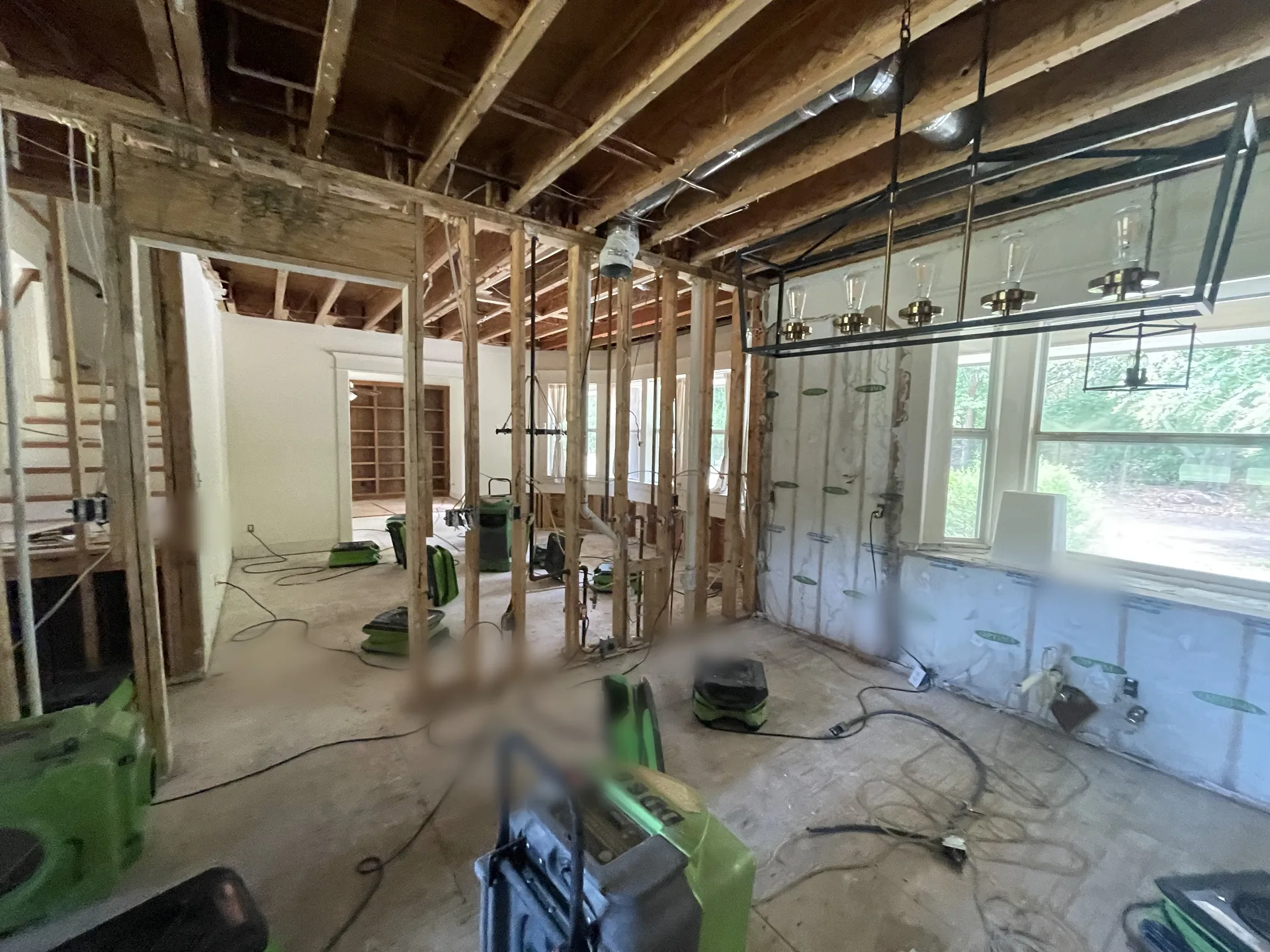
Fort Worth — flood-cut drywall and drying equipment during structural drying Fort Worth — opened ceiling cavity during water mitigation Fort Worth — opened ceiling and air movers during water mitigation Fort Worth — flood-cut drywall during structural drying Fort Worth — air movers in a bathroom during structural drying Fort Worth — flood-cut drywall and drying equipment Dallas Design District — air movers in an occupied corridor Dallas Design District — dehumidifier on an occupied corridor Dallas Design District — air movers on an occupied corridor Fort Worth — air movers on a kitchen island and hardwood Fort Worth — occupied sitting room during drying
★★★★★ · Water · Brandon Urbanovsky · Google
“After a major water loss in our home, we contacted PRC.HOMES and the experience was on a completely different level than a typical restoration company. Their team approached the project with a true structural and building-science mindset instead of just throwing fans around and hoping for the best.”
★★★★★ · Water
“My home had damage from a water leak that needed immediate attention. The Public Restoration Company responded promptly to assess the problem. I worked with Nick, who was kind, professional, and very patient in answering all of my questions.”
Barbara LucksGoogle review
“The quality of their work exceeded expectations. Nick was punctual, respectful of the property, and kept everything clean and organized throughout the project. What stood out most was their commitment to doing the job right the first time while keeping me informed every step of the way.”
Calvin JowersGoogle review
Water damage FAQs
How long does drying take?
It depends on how much water got in, what it soaked and what the meters read. The timeline follows moisture readings, not a calendar promise. PRC checks readings during the job and keeps a drying log until the structure reaches the dry standard.
Are household fans enough?
No. Wall cavities, floors and cabinets need a mapped dry, and household fans can't show what is still wet inside them. Equipment follows moisture readings, not a fixed fan package, and it stays until the meters say the materials are dry.
Do you just set equipment and leave?
No. We take starting moisture readings, set fans and dehumidifiers from those readings, check the dry-down, and keep a drying log. Equipment comes out when the readings show the materials are dry, not on a set day.
What is a dry standard?
It is the moisture content PRC dries to, compared with unaffected material in the same house. Equipment stays until the meters show the wet materials are there, not until a set number of days has passed.
Can I dry water damage myself with rented equipment?
Sometimes. A small clean-water spill on a hard floor can be dried with fans and a dehumidifier. Water that reached walls, subfloors, insulation or cabinets is harder, because you can't see how wet it still is. PRC measures moisture and dries to a dry standard, then documents the readings. Not sure? Call us.
What should I do first when water gets into my house?
Stop the source if you can by shutting off the water at the main valve. Turn off power to wet areas only if you can reach the panel safely. Move valuables out of the water and take photos before cleanup. Then call us so drying can start.
What gets removed after water damage and what gets dried?
It depends on the water and the material. Clean-water-soaked drywall, hardwood and cabinets can often be dried in place when caught early. Carpet pad and insulation are more often removed, and porous materials touched by sewage water are removed. PRC checks moisture readings before deciding what stays.
Why can a wall feel dry and still be wet?
Surfaces dry first. Water can stay in insulation, framing, the wall cavity or under flooring where you can't touch it. Moisture meters and thermal cameras show what is still wet behind the surface, which is why PRC maps moisture and rechecks readings instead of judging by feel.
Is it safe to stay in the house while it is being dried?
Often yes, when the water is clean, the power is safe and equipment can be placed so you can live around it. Sewage water, wet electrical or a sagging ceiling changes that. PRC works in occupied homes. Call us and describe what you see.
What is the difference between water mitigation and water damage restoration?
Mitigation is the emergency work: stopping further damage, extracting water, removing what can't be saved and drying the structure. Restoration is the repair that follows, such as drywall, flooring, cabinets and paint. PRC does both, so one team can carry the job from drying to rebuild.
Can wet carpet be saved?
Sometimes. Carpet soaked with clean water and extracted quickly can often be dried, though the pad underneath is more often removed. Carpet that touched sewage water is removed. A technician checks moisture readings and the type of water before deciding.
Do you dry water damage in apartments and condos?
Yes. Water in one unit often reaches the unit below or shared walls, so drying is planned across the affected areas. PRC coordinates access with owners and property managers and documents each area. See our condo contents versus building guide for who is responsible for what.
Do I have to use the contractor my insurance company suggests?
No. In Texas, you choose who repairs your home, and a contractor list from an insurance company is optional. PRC documents the damage with photos, moisture readings and a written scope, so your insurance company has what it needs to review. Call us with questions.
Tell us what happened
If water is still moving, call first. The form is not a same-day dispatch. It's for details once the source is stopped.
Water moving, fire just out, or roof open? Call us now.
Stable? Send details below. Answered 24/7.