
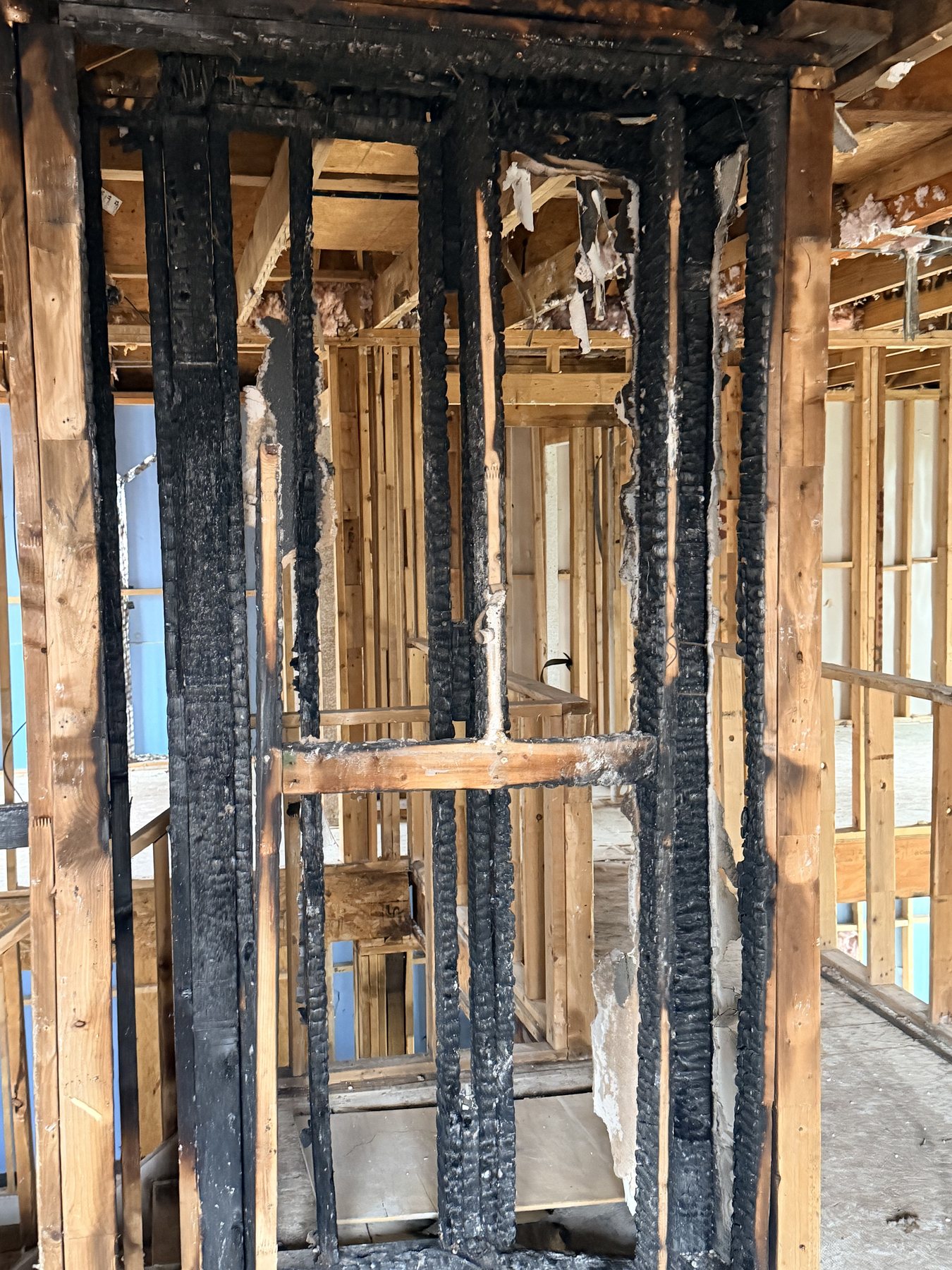
The flames in a kitchen fire are usually small and out in minutes. The smoke is a different story. It leaves the kitchen first, and it takes soot with it. If you are dealing with kitchen fire smoke damage in Fort Worth, this is what is happening in the rest of your house and what to do before you wipe, spray or paint anything. For what we do on the structure itself, start at our page on fire damage restoration in Fort Worth.
Cooking is by far the leading cause of home fires, and it peaks around the holidays. The National Fire Protection Association (NFPA) says Thanksgiving is the peak day for home cooking fires, with more than three times the daily average, and Christmas Day and Christmas Eve rank second and third. A holiday cooking fire in Fort Worth follows the same pattern: more people, more dishes, and a stove nobody is watching.
Why a small kitchen fire reaches the whole house
Most cooking fires never get far. The U.S. Fire Administration reports that 93% of residential cooking fires were confined to the contents of the cooking vessel. The fire stays in the pot. The smoke does not stay in the kitchen.
Smoke follows air, not walls
Smoke and combustion residue move into attic cavities, HVAC returns and supplies, wall voids and rooms that never saw flame. The walls in a hallway can look fine in a photo and still wipe gray on a glove. That is soot, not dirt.
What a grease fire leaves behind
A grease fire leaves a sticky film. It looks like very little and it smears the moment you touch it. A fire that burned plastics, carpet or foam leaves something drier and harder to lift. We test a small area first, because the wrong method can push soot deeper into paint or fabric.
Why the air handler matters
A small kitchen fire can load the whole house if the air handler kept running. If the system ran during or after the fire, smoke went wherever the air went. We check the returns, the supply registers and the air handler. Our smoke and soot cleanup page lists what that includes.
First, make sure the fire is out and everyone is safe
The American Red Cross says to stay out of a fire-damaged home until local fire authorities say it is safe to re-enter. If you smell gas or hear hissing, leave right away and call the fire department from a safe place.
If the fire department had to open a window, a door or a wall, the house is open to weather and anyone walking by. Emergency board-up closes the openings so the house holds overnight.
The first hour
Turn off the HVAC system and the thermostat
This is practical guidance from our fire jobs, not a study. A running system pulls smoke into the return and pushes it down every duct. Switch the thermostat to off until the house has been cleared and someone has looked at the filter, the returns and the air handler.
Open windows only if it is safe and the weather allows
The U.S. Environmental Protection Agency (EPA) says that when you clean up indoors after smoke or ash, open windows and doors if conditions permit and use fans to move air out. That page is about wildfire ash, but the point carries. Fresh air helps with the air. It does not lift soot that has already landed on surfaces.
Photograph before you wipe anything
Wide shots of every room first. Then close-ups of soot on the ceiling, the vents, the cabinets and the stove area. Photograph the cookware and any food or contents you plan to throw away before they leave the house. Once soot is wiped or the damaged material is gone, the file gets thin. We go through what a good file includes in what we document after water or fire damage.
Do not scrub soot with household cleaners
Soot is a fine residue that settles on every surface and gets into porous ones. Household cleaners and dry rags push it around, and a regular vacuum can send fine particles back into the air. Leave painted walls and ceilings around the stove, cabinets, grout, fabric and the vents alone until someone has looked at them.
Do not use fog, spray or paint to cover the odor. Sealing over a dirty surface holds the smell in. Sealer goes on only after the material is clean and sound.
The first 24 hours, in order
- Now through the first hour. Fire department clears the house, HVAC off, photos taken.
- The next few hours. Close up any opening the fire department made. If hose or sprinkler water hit the floors, walls or ceiling, that is a water loss too, and it keeps working while you wait. See what a house fire with smoke and water looked like on one of our jobs, and the full house-fire checklist.
- Food and cookware. The Red Cross says to discard food exposed to heat, smoke or soot. Photograph it first. For larger items, ask before you throw anything out.
- The next day. Walk the house with the windows open. Soot or a film in more than one room, or a smell that is still there, is your signal to call. Do not start cleaning to find out.
What can be cleaned and what has to be replaced
Hard surfaces like tile, metal, glass and sealed wood often clean. Insulation, unsealed drywall, carpet and pad, and some cabinet interiors usually do not. We write down which is which, with photos, so the scope matches what the house needs. Contents are sorted the same way: wipe and keep, or let go.
If the fire opened a ceiling or burned into a wall, the structure comes first. See how we stabilize, document, scope and rebuild and reconstruction after fire for what that looks like once finishes have to come out.
When to call a restoration company
Call when any of these are true:
- Soot or smell is in more than one room
- There is a film on walls or ceilings away from the kitchen
- The fire department opened walls or ceilings, or used water
- The smell is still there the next day with the windows open
If it is the middle of the night or the house is open, use our emergency line. If you are not sure, send the photos and ask.
Before the holiday cooking starts
This section is the fire-safety agencies, not us.
- NFPA says unattended equipment is a factor in one quarter of home cooking fires,.
- For a pan fire, NFPA says to slide a lid on the pan and turn off the burner, and never use water. For an oven fire, turn off the heat and keep the door closed.
- The American Red Cross North Texas Region, with the Arlington Fire Department, says to fry a turkey outdoors, at least 10 feet from the home, on a sturdy level surface.
- The U.S. Consumer Product Safety Commission recommends a working smoke alarm on each level, outside sleeping areas and inside bedrooms. The Fort Worth Fire Department says to test them monthly and replace the detector every 10 years.
Common questions
Here are the questions we get most after a cooking fire. For more, see fire and restoration questions.
How far does smoke travel after a small kitchen fire?
Farther than the fire did. Smoke and soot follow moving air into the HVAC returns, attic cavities, wall voids and rooms that never saw flame. A small fire in the kitchen can leave residue in a bedroom down the hall.
Should I turn off the HVAC after a cooking fire?
Yes, until the house is cleared and someone has looked at the filter and the returns. A running system pulls smoke and soot into the ducts and pushes it to every room. Leave it off and call a restoration company if you are not sure.
Can I clean kitchen soot off walls and cabinets myself?
Not before you photograph it. Household cleaners and dry wiping can smear soot into paint, grout and fabric, and a regular vacuum can put fine particles back in the air. Leave the surfaces alone until you know what is cleanable and what has to be replaced.
Why does my house still smell like smoke the next day?
The smell lives in the residue on surfaces and in the cavities behind them. Air freshener and fog do not remove it, and sealing over a dirty surface holds the smell in. If it is still there the next day with the windows open, soot has traveled and it needs to be found.
What should I photograph after a kitchen fire?
Wide shots of every room first, then close-ups of soot on ceilings, vents, cabinets and the stove area. Also photograph the cookware, food and contents you plan to discard before anything leaves the house. Do it before you wipe or throw anything out.
When should I call a restoration company after a cooking fire?
Call when soot or smell is in more than one room, when a film is on walls away from the kitchen, when walls or ceilings were opened, or when the fire department used water. Answered 24/7. You choose your contractor.
Smoke or soot in your house?
If the fire is out and you are standing in a house that smells like it, do not start scrubbing. Take your photos, turn the HVAC off and call us. We work across Fort Worth and DFW, and we can board up the same day when the house is open. Call 817-632-2522, answered 24/7, or contact PRC with photos and the address. You choose your contractor.
Sources
- NFPA, Thanksgiving: home fire safety
- NFPA, Cooking: home fire safety
- U.S. Fire Administration, Cooking fire prevention
- U.S. Fire Administration, Cooking fires in residential buildings
- American Red Cross, Home fire recovery
- American Red Cross, Checking your home after a fire
- American Red Cross North Texas Region, Thanksgiving turkey frying and cooking safety tips
- U.S. EPA, Protect yourself from ash
- U.S. Consumer Product Safety Commission, Safe cooking tips for the holiday season
- City of Fort Worth Fire Department, Smoke detectors